Guest Lecture Recap: Substance Use, Trauma, and Rethinking Resilience
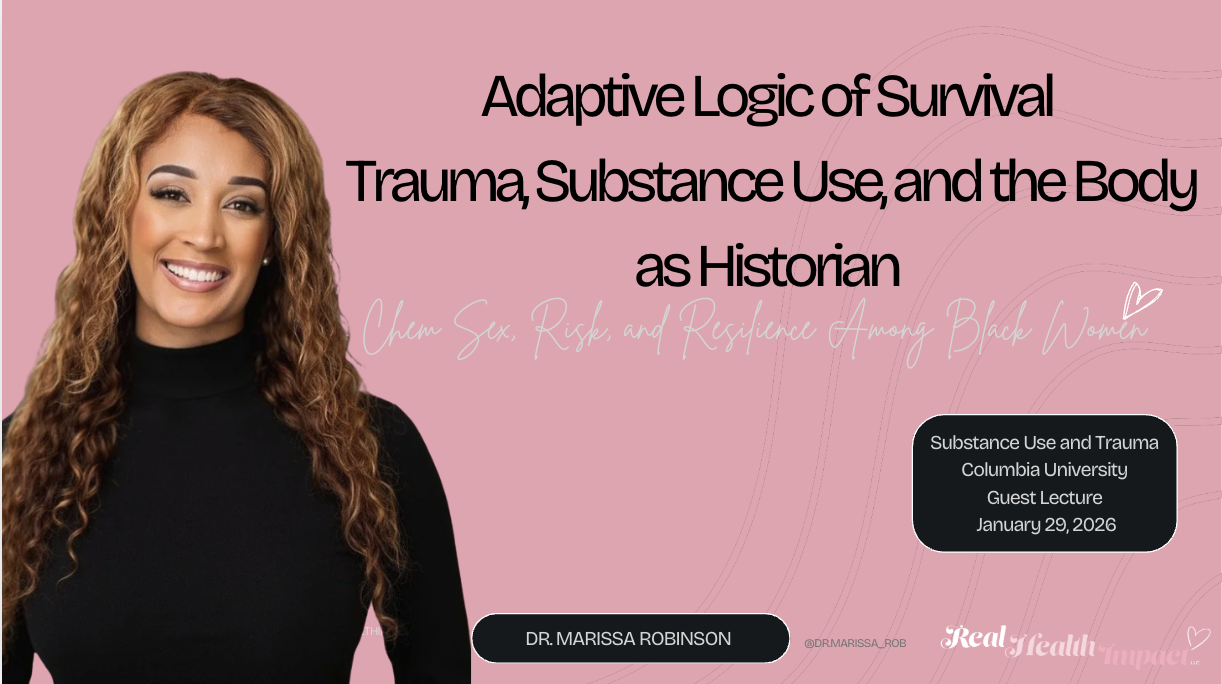
I had the honor of guest lecturing for Dr. LA McCrae’s course on substance use and trauma at the Columbia University School of Social Work. The conversation was honest, grounded, and deeply human.
We centered the session on a core truth that often gets lost in public health and clinical spaces. What helps you survive might not help you heal.
Much of what we label as coping, resilience, or even noncompliance are survival strategies shaped by trauma, instability, and systems that fail to protect people. Those strategies can make sense in the moment and still cause harm over time.
One of the key themes we unpacked was the way “resilience” is often used in health and social systems. When resilience is framed as an individual trait rather than a response to systemic harm, it can quietly gaslight people into believing they should simply endure more.
Instead of asking why people are not more resilient, we need to ask why they are being asked to survive conditions that require constant resilience in the first place. The work is not to strengthen coping alone but to challenge the systems that create chronic harm.
We also spent time reframing cravings. Rather than treating cravings as a biological failure or moral weakness, we explored them as somatic signals and attempts to regulate safety.
When cravings are met with shame, the cycle tightens. Shame fuels self hatred, which reinforces triggers and deepens harm.
Naming cravings as information rather than indictment opens the door to compassion and more effective intervention. It shifts the question from “what is wrong with you” to “what is your body trying to protect you from.”
Another critical discussion focused on chemsex, or the intersection of substances and intimacy. We talked about how chemsex is often driven by survival needs such as connection, safety, and belonging, not just substance use alone.
We emphasized the importance of distinguishing between survival and work. Survival is not optional, while work is, and confusing the two can unintentionally enable rationalizations that increase risk for relapse.
Finally, we grounded the session in a systems level truth.
Addiction is not an individual failure, it is a systemic one.
Sustainable solutions require involving people with lived experience from the very beginning, not as an afterthought or advisory box to check.
Programs designed with communities, rather than for them, are more responsive, ethical, and effective.
I am deeply grateful to Dr. McCrae and the students for holding space for this conversation with care, curiosity, and rigor. These are the future practitioners and leaders who will shape what healing looks like.
And that matters.